Why Referrals No Longer Scale for Technical Advisory Firms

Most Norwegian technical advisory firms were built on referrals. A senior engineer leaves an operator, founds the firm, brings five clients with him. A managing partner spends a decade on the conference circuit and is in everyone’s contact list. A handful of projects with Equinor or Aker turn into a steady stream because the work was good and the right people remembered.
This is not a fragile model. It is the model that built the Norwegian technical advisory sector, and it has worked for forty years. It also has a ceiling.
The ceiling is not a sign that anything has been done wrong. It is a structural property of how relationship-based growth interacts with international procurement. Most firms hit it without recognising what they are looking at.
What the referral model actually delivers
The referral model produces a particular shape of pipeline:
- Inbound enquiries from operators inside the firm’s first- and second-degree network
- A high conversion rate on those enquiries, because trust is already established
- Concentration: a small number of operator names produce most of the work
- Predictability within those names, volatility outside them
- Reach roughly equal to the social graph of the firm’s principals
That last point is the one that matters at scale. The reach of a referral model is the reach of the relationships behind it. If those relationships sit primarily in Stavanger, Bergen, and Oslo, the firm’s pipeline reflects that geography. If they extend into Aberdeen and the wider North Sea, the pipeline extends with them. If they do not reach Houston, Singapore, or São Paulo, neither does the pipeline.
This is fine until international growth becomes an objective. Then the geometry stops working.

Why international procurement does not sit in the network
A procurement analyst at a US operator, a UK EPC, or a Continental developer is not in the social graph of a Stavanger-based founding partner. Their predecessors might have been, twenty years ago. The current generation is younger, distributed across multiple offices, and operates within procurement frameworks that explicitly require structured supplier research.
When that analyst needs to source a specialist for a specific scope, the first step is rarely a phone call to a colleague in Norway. The first step is a structured search. They build a longlist from web research, internal supplier records, and industry registers. They sense-check that longlist with internal stakeholders, some of whom may know firms in the niche. They narrow to a shortlist.
A firm that exists only in the social graph of one country is not absent from this process because the buyer rejected it. It is absent because the buyer never encountered it.
This is the part that surprises managing partners. The model that has produced inbound work for twenty years simply does not produce inbound work from outside the network, and that has become more obvious as international procurement has moved further away from the old conference-and-handshake pattern.
The shift to research-led shortlisting
The underlying change in international procurement, over the last decade, has been quiet but consistent.
Three drivers:
- Generational turnover. The procurement analysts and project managers now drawing longlists came up in a world where the first step in any sourcing exercise is a structured search. The phone call comes later, if at all.
- Compliance and audit pressure. Major operators and EPCs face increasing requirements to document supplier selection. A defensible procurement record needs structured research behind it, not a single referral.
- Geographic distribution of procurement. Operators that historically procured technical advisory work from a single regional hub now run sourcing across multiple offices. A relationship in one geography does not carry into another in the way it once did.
The result is that the share of international procurement decisions reached through structured supplier research has grown sharply, and the share reached through pure referral has shrunk. For Norwegian technical firms, this matters more than it does for in-country competitors, because Norway is structurally a smaller home market than the international opportunity.
What the ceiling looks like
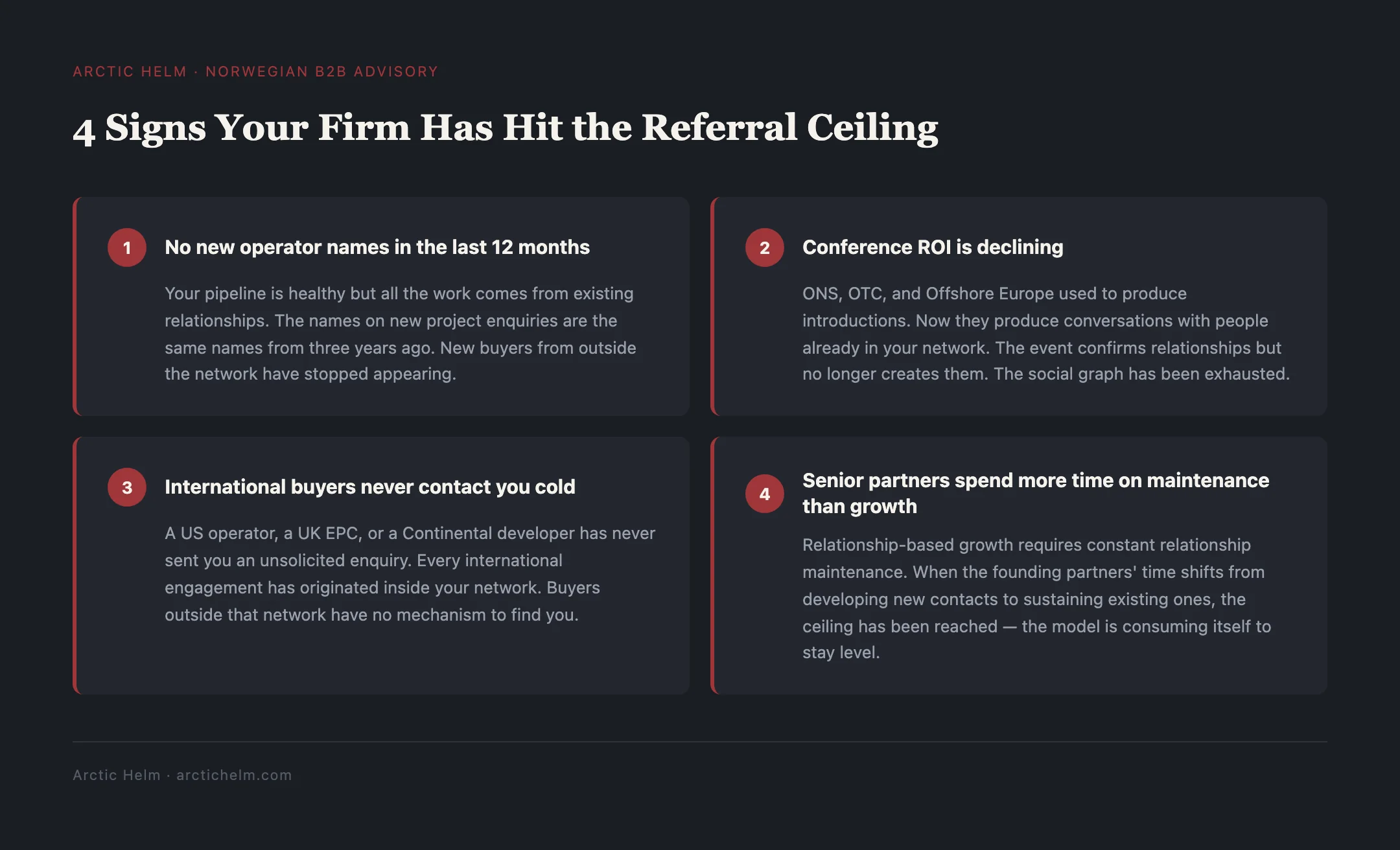
The ceiling does not arrive as a crisis. It arrives as a flat line.
The most common shape:
- Revenue from existing operator relationships remains steady or grows slowly
- New operator names — particularly international — stop appearing in the pipeline
- Conference and trade-event ROI declines, because the conversations confirm what the firm already knows rather than introducing new buyers
- Inbound enquiries become less frequent and more concentrated in known names
- Senior partners spend more time on relationship maintenance to keep existing accounts active
None of this looks like failure on a quarterly review. The firm is profitable, busy, and well-regarded. The growth, however, has stopped, and the firms that were peers five years ago — the ones that started showing up in international procurement research — are pulling away.
This is the ceiling. It is rarely diagnosed correctly the first time. The instinct is to do more of what previously worked: more conferences, more relationship calls, more time on the road. That treats the symptom and leaves the structural cause in place.
What comes after network-only growth
The honest read is that the referral channel does not need to be replaced. It needs to be supplemented.
Referrals continue to convert at high rates inside the existing network. They are durable and valuable. The addition is a second channel — buyer research — that brings the firm into consideration sets it currently cannot reach.
For Norwegian technical advisory firms, that second channel has three components that work together:
- A web presence that matches how international procurement teams search, not how the firm describes itself internally
- Leadership visibility on LinkedIn for at least one or two principals, so that the people behind the firm are findable and credible when buyers cross-reference names
- A small amount of published thinking that gives a procurement analyst something concrete to read when they evaluate fit
This is not marketing in the consumer sense. It is procurement readiness made visible. The change in pipeline, when it arrives, is in inbound enquiries from operator names the firm has not historically worked with — the names that previously could not find the firm at all.
For deeper context, read Norwegian Engineering Consulting: Why Your Firm Doesn’t Appear on International Procurement Shortlists and The Complete Guide to Online Visibility for Norwegian Technical Firms.
The honest read
The referral model is not broken. It is bounded. The bound is the network behind it. If your firm’s growth ambition extends beyond that network, the work is not to abandon what built the firm. The work is to add the channel that lets international buyers find you when they are already looking.
Related reading: Why Strong Norwegian Engineering Firms Lose Bids Before the RFP Stage.
If you would like an outside read on where the ceiling sits for your firm and what addition would matter most, start a conversation. An honest no is as useful as a yes.