Why Your Firm Doesn't Appear in International Procurement Searches

A capable Norwegian firm with thirty years in subsea engineering does not appear when a procurement analyst in Houston, Aberdeen, or Copenhagen searches for the work they do. This is not a failure of effort or experience. It is a structural condition that almost every mid-size Norwegian technical firm shares.
The instinct is to call it a marketing problem. It is not. It is a presence problem, and the difference matters.
How procurement teams actually search
When a procurement analyst sits down to build a longlist for a specialist engagement, they do not type “engineering firm.” They type the scope.
The pattern looks like this:
- A primary scope query: “marine geotechnical survey contractor North Sea”
- A discipline cross-check: “offshore pipeline integrity assessment Arctic”
- A regulatory or standards query: “DNV-RP-F116 compliance specialist”
- An adjacency check: “subsea structural analysis vendors Norway”
- A name validation pass on the firms that appear, against LinkedIn and any internal records
The work is multi-query, multi-region, multi-stage. A serious supplier evaluation begins with twenty to forty searches across an hour or two, then narrows. By the end of that session the analyst has a working longlist and a discard pile. Firms that did not appear during those searches are in neither — they are simply absent from the exercise.
This is the part most engineering firms underestimate. The procurement team is not making a judgement about your firm. They are not aware your firm exists.

“We have a website” is not presence
Most Norwegian technical firms have a website. Some are recent. Some are clearly older. Almost all are organised around an internal logic — about, services, projects, contact — with text that describes what the firm does in the firm’s own vocabulary.
That is not the same as presence. Presence in procurement research means:
- Pages exist for the specific scopes a buyer is searching for, not abstract service categories
- The page can be found by a buyer typing the search terms a procurement analyst actually uses
- Once found, the page contains enough detail that a buyer can confirm scope fit without writing an email
- The firm’s principals are visible and credible when their names are cross-referenced
A homepage that says “we provide engineering services across the offshore sector” is invisible to all four of those tests. It does not match a search term. It does not confirm a scope. It does not survive sense-checking. It does not tell a buyer who is responsible for the work.
This is not a failure of website quality in the design sense. The site can be modern, fast, well-built. It is a failure of legibility in early-stage supplier research.
The specifics matter
A subsea engineering firm I spoke with last year had a service page titled “Subsea Engineering.” It was 180 words. It listed capabilities at a high level. It contained no reference to specific standards, specific water depths, specific tool stacks, or specific operator environments they had worked in.
A procurement analyst evaluating a deepwater pipeline integrity scope for the Norwegian Sea is searching for a contractor who can demonstrate, on the page, that they have done work matching the scope. The 180-word page cannot do that.
The same firm had thirty years of project history that would have satisfied any reasonable evaluation. None of it was on the website in a form a search engine could find or a procurement analyst could read. The work existed. The presence did not.
This is the gap, and it is almost universal in Norwegian technical advisory firms. The work is excellent. The legibility of the work, during the window in which buyers are looking, is thin.
Examples by niche
The pattern is the same across sectors, but the specific failures differ.
Subsea engineering. Firms describe themselves as “subsea engineering consultants” while procurement teams search for “subsea integrity management,” “pipeline freespan analysis,” “deepwater riser engineering,” and similarly specific terms. The mismatch is not subtle.
Offshore wind and marine geoscience. Floating wind has produced an entire vocabulary that did not exist five years ago — mooring systems, anchor design, seabed survey for floaters, dynamic cabling. Firms that have done the work often have not written about it in those terms.
ESG and regulatory advisory. Buyers search by regulation: CSRD, EU Taxonomy, methane emissions reporting. Firms describe themselves as “ESG consultants.” A procurement team building a shortlist for a specific regulatory engagement filters on the regulation, not the category.
Renewables and energy transition. The newer the niche, the larger the language gap. Firms that have moved fastest in writing about specific subsectors are picking up early framework work simply because they are findable in those terms.
What presence actually requires
Becoming present in international procurement research is not a content marketing exercise. It is a procurement-facing rewrite of how the firm is described in public.
Practical components:
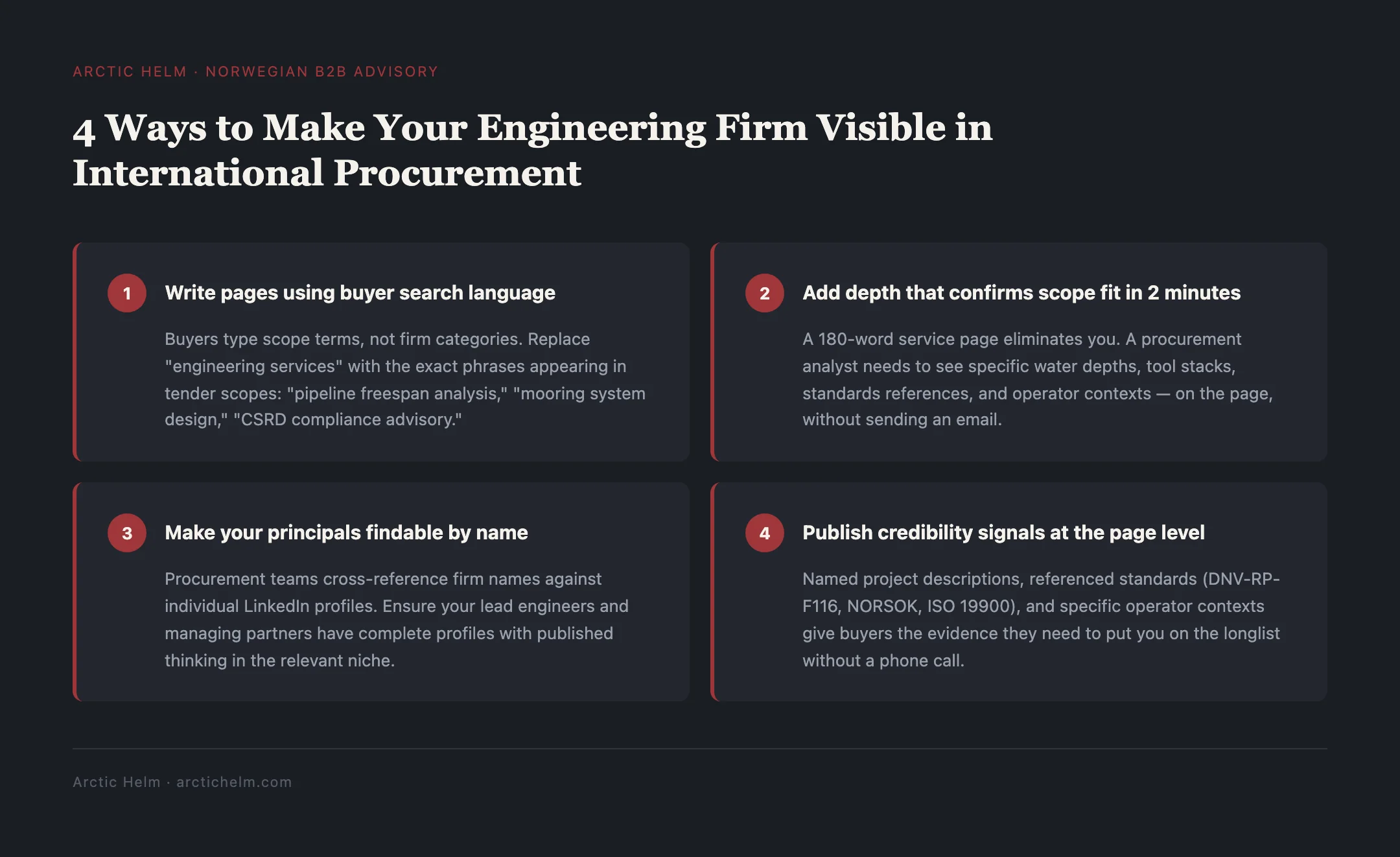
- Pages built around the scope language buyers use, not the internal categories the firm uses
- Depth that lets a procurement analyst confirm scope fit in two minutes
- Named principals with sufficient LinkedIn visibility to survive a sense-check
- Credibility signals — specific projects, specific standards, specific operator contexts — at the page level
For the wider context, read SEO for Engineering Companies and the Complete Guide to Online Visibility for Norwegian Technical Firms.
The work is not loud. It is not promotional. Most of it is a quiet reorganisation of substance the firm already has into a form that international procurement can find and read.
The diagnostic
If your firm has not been invited into a procurement process by an international buyer outside your existing network in the last twelve months, the most likely cause is not the work. It is that the buyer searched, and you were not there.
The test is straightforward: list the five terms an international procurement team would type into Google to find a firm like yours. Search them. Note where your firm appears, if at all. The result is your current presence in early supplier evaluation.
Related reading: Why Strong Norwegian Engineering Firms Lose Bids Before the RFP Stage.
If you would like an outside read on where your firm sits in international procurement research, start a conversation. The first read is honest, whether it points toward working together or not.