Why Strong Norwegian Engineering Firms Lose Bids Before the RFP Stage

A managing partner at a Norwegian subsea firm told me last month that they had lost three framework opportunities in eighteen months. In each case they found out late — once through a contact at the operator, twice from a competitor mentioning the win at a conference.
In none of those three did the firm receive an invitation to bid.
The instinct is to ask what went wrong at the RFP stage. The answer is that nothing went wrong at the RFP stage, because the firm was never at the RFP stage. The work was lost weeks earlier, during the part of procurement most engineering firms never see.
The longlist is drawn before anyone calls you
A formal RFP is the visible part of a procurement decision. It is also the late part.
By the time a procurement team at Equinor, Shell, Ørsted, or a tier-one EPC issues an RFP, they have already done the following:
- Defined the scope and technical requirements internally
- Pulled their preferred-supplier register for relevant firms
- Run multi-stage web research to identify firms outside that register
- Cross-referenced names with internal stakeholders for sense-checking
- Drawn a longlist of eight to fifteen firms
- Narrowed that longlist to a shortlist of three to five
The RFP goes to the shortlist. Occasionally the longlist is the same as the shortlist if the scope is unusual or the niche is thin. Either way, the decision about which firms can win is made long before the document hits anyone’s inbox.
If your firm is not in the longlist, the RFP cannot reach you. There is no mechanism for a procurement team to remember a firm they could not find.

What “discovery before contact” actually looks like
The term sounds abstract. The reality is mechanical.
A procurement analyst at a North Sea operator is given a scope: marine geophysical survey support for a planned floating wind site, with specific bathymetric and geotechnical requirements. They have ninety minutes blocked for initial supplier research.
They search “marine geophysical survey Norway.” They search “floating wind seabed survey contractor.” They search the same terms in English and occasionally in Norwegian. They scan LinkedIn for firms posting recent work in the niche. They check Achilles, JQS, and one or two industry registers. They take notes.
Ninety minutes later they have a working longlist of perhaps twelve firms. Some are obvious — DNV, Fugro, large operators of survey vessels. The rest are mid-size specialists who were findable. Firms that did not appear during that ninety minutes are not on the list. There is no second pass.
This is not unusual. It is the standard pattern. The window in which your firm has to be visible is short, and you do not know when it opens.
The disqualifying step is silence
Most of the firms I work with assume the competitive risk lives at the RFP stage — that they need a better proposal, a sharper differentiator, more polished case studies. Sometimes that is true. More often the firm has the substance and never gets the chance to use it, because the disqualifying step is happening earlier and quieter.
A few patterns I see repeatedly in Norwegian technical firms:
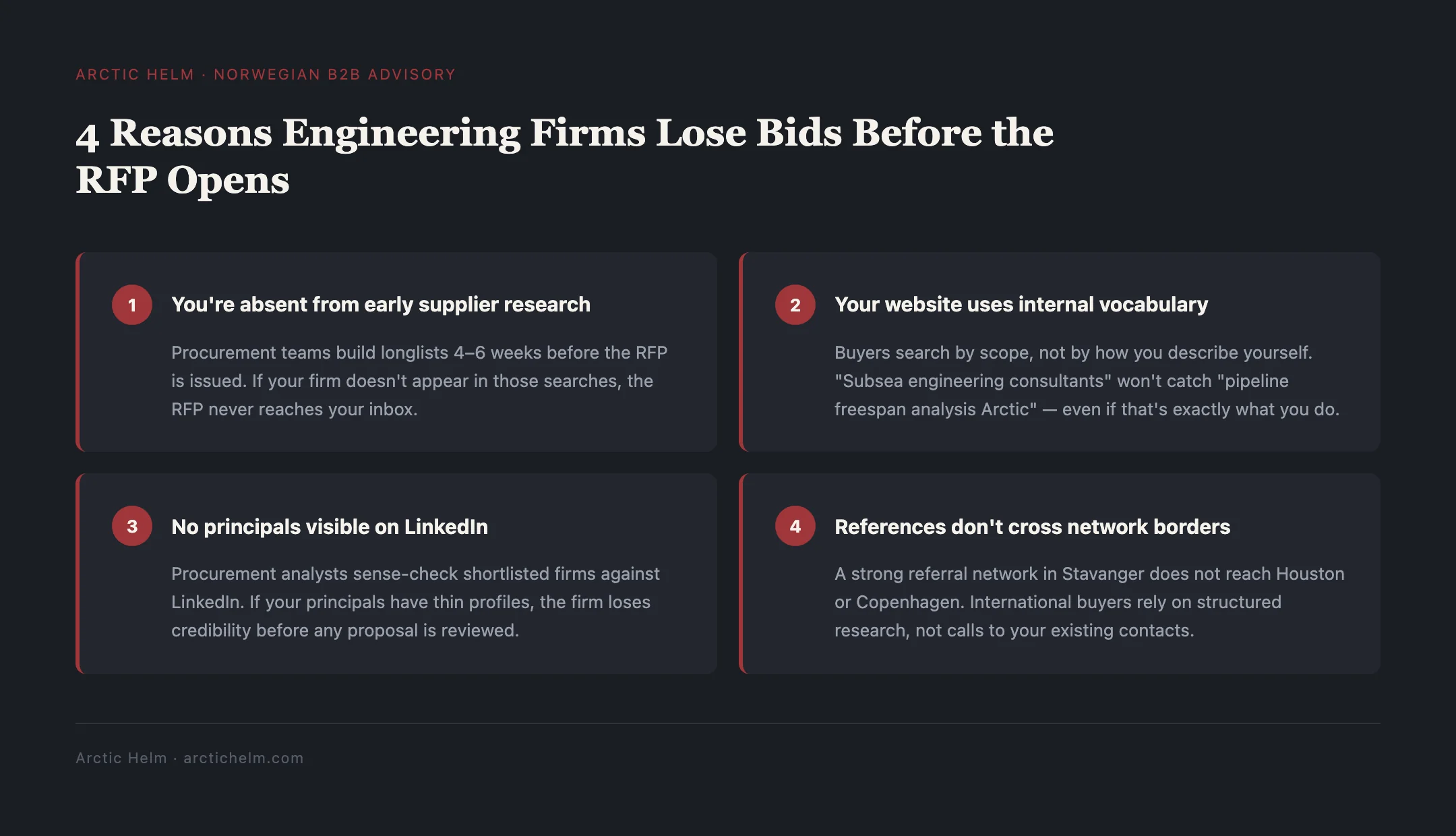
- A capable subsea or marine geoscience team with deep operator references, no website depth beyond a homepage and an “about” page, and almost no presence in search for the terms their international buyers use.
- Strong individual reputations among principals, no published thinking under their names, no content trail a procurement analyst would find when sense-checking.
- LinkedIn company pages that confirm the firm exists, but tell a buyer nothing about whether the firm matches the scope in front of them.
None of this is a marketing failure in the soft sense. It is a procurement-readiness failure. The work the firm does is excellent. The information a buyer needs to consider that work is not where buyers look.
What being on the longlist actually requires
The longlist is built from public information. To be on it, your firm needs to be legible during the window when procurement teams are looking. That breaks down into a small number of practical conditions:
- Pages that match the search terms used by international procurement, not the internal vocabulary your firm uses with existing clients
- Enough depth on those pages that a procurement analyst can confirm scope fit without picking up the phone
- Credibility signals — named principals, specific project descriptions, technical detail — that survive a sense-check inside the buyer’s organisation
- Leadership visibility on LinkedIn for at least one or two principals, so that when a buyer searches the firm name, the people behind it are real and active
This is not a content programme in the marketing sense. It is supplier-readiness made visible. The point is to be considered, not to be loud.
For the full picture of how this fits together, read The Complete Guide to Online Visibility for Norwegian Technical Firms.
What changes when the firm is in the longlist
The change is rarely dramatic in the first month or two. The work is quiet. Then, somewhere between month three and month six, a different pattern starts.
Invitations to bid arrive from operators the firm has never spoken to. The questions on intro calls shift — buyers reference specific pages on the website, name a principal whose LinkedIn post they read, ask about a niche the firm has explicitly written about. The firm starts hearing about opportunities before the conference circuit confirms them.
This is what being on the longlist does. It does not guarantee the contract. It guarantees you are in the conversation where contracts get decided.
The honest read
If your firm has lost two or more international opportunities in the last twelve months without ever receiving an invitation to bid, the issue is almost certainly upstream of the RFP. It is not a proposal problem. It is a discovery problem.
The diagnostic is simple: search the terms an international procurement team would use to find a firm like yours. If your firm does not appear in the first ninety minutes of that work, neither does it appear in theirs.
Related reading: Why Your Firm Doesn’t Appear in International Procurement Searches.
If you want a direct read on where your firm sits in early procurement research today, start a conversation. An honest no is as useful as a yes.