LinkedIn for Engineers: How International Buyers Vet Norwegian Technical Firms Before the First Call

Most Norwegian engineering firms have a LinkedIn page. It exists. It has a logo, a banner, and a description written three years ago. Once a month, someone posts a photo from a conference or a hiring update.
This is not a LinkedIn strategy. This is a digital noticeboard.
Meanwhile, your competitors are using LinkedIn to position their principals as the experts international buyers trust before they pick up the phone. The gap is not talent. It is visibility.
What does not work
Company page broadcasting. Nobody follows your company page to read press releases. Company pages have low organic reach by design. LinkedIn rewards personal profiles, not brand accounts.
Posting job ads as content. Hiring posts get engagement from job seekers, not buyers. They do nothing for your authority.
Sharing industry news without a point of view. Reposting a DNV report with “Interesting read” is not thought leadership. It tells your audience nothing about your expertise.
Irregular posting. One post in January, silence until April, then a conference photo. LinkedIn rewards consistency. Sporadic activity is worse than no activity because it signals abandonment.

What actually works
The firms winning on LinkedIn do three things consistently.
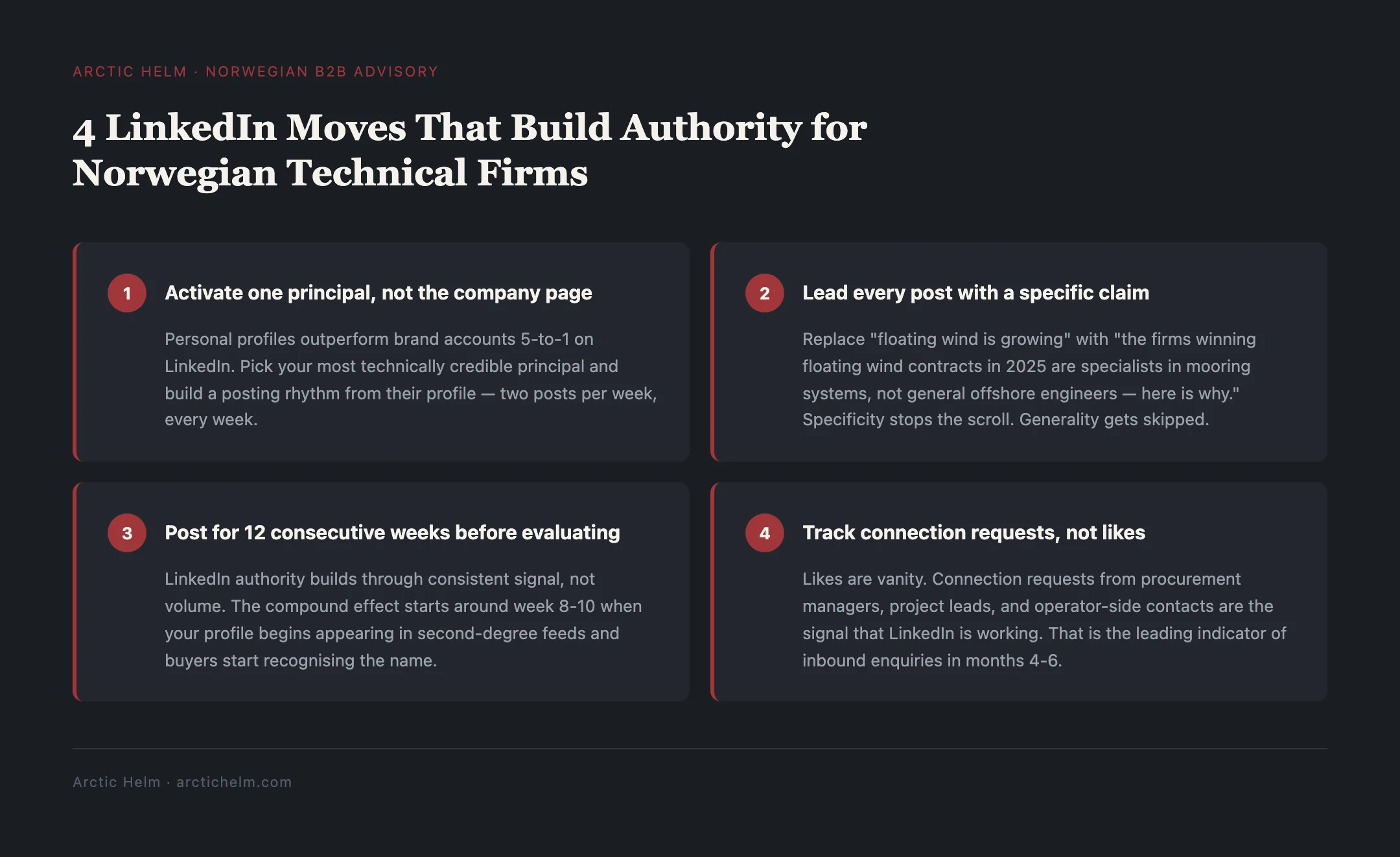
1. They lead with personal profiles
Your technical director, your managing partner, your lead engineers. These are the profiles that build trust. Buyers want to hear from the person they will work with, not from a logo.
A subsea engineering principal sharing lessons from a recent North Sea project will outperform any corporate post by a factor of five.
2. They publish a point of view
The difference between content that builds authority and content that gets scrolled past:
Scrolled past: “Floating wind is an exciting growth area for the Norwegian offshore sector.”
Stops the scroll: “Every offshore engineering firm is chasing floating wind. Most are positioning themselves identically. Here is why the firms that win the next wave of contracts will be the ones who specialise in mooring systems, not general engineering.”
Specificity signals expertise. Generality signals that you have nothing to say.
3. They post consistently
Two posts per week from one principal is better than five posts one week and silence for a month. The compound effect matters. After 12 weeks of consistent posting, your profile becomes a reference point in your niche.
The compound effect
LinkedIn authority compounds the same way SEO does. The first month feels like nothing. By month three, your posts start appearing in the feeds of second-degree connections. People you have never met start recognising your name.
By month six, inbound messages start arriving. “I have been following your posts. We have a project coming up.”
How this connects to search visibility
LinkedIn authority and search visibility reinforce each other. A principal who ranks on Google for “offshore engineering consulting” and publishes thought leadership on LinkedIn creates a closed loop. Buyers find you on Google, then validate you on LinkedIn. Or they discover you on LinkedIn, then search your firm.
Neither channel works as well alone. This is why Arctic Helm works three tracks in sequence: Search first, then Authority, then Social.
The practical starting point
If your firm has done nothing on LinkedIn beyond the company page:
- Pick one principal. The one most comfortable writing or speaking about their work.
- Define three topics. What do they know that buyers need to hear?
- Write two posts per week. 150-300 words each. Real experience, specific examples, a clear point of view.
- Track connection requests and inbound messages. This is the leading indicator.
For the full picture, read The Complete Guide to Online Visibility for Norwegian Technical Firms.
Ready to build authority where your buyers are already looking? Get your visibility plan.